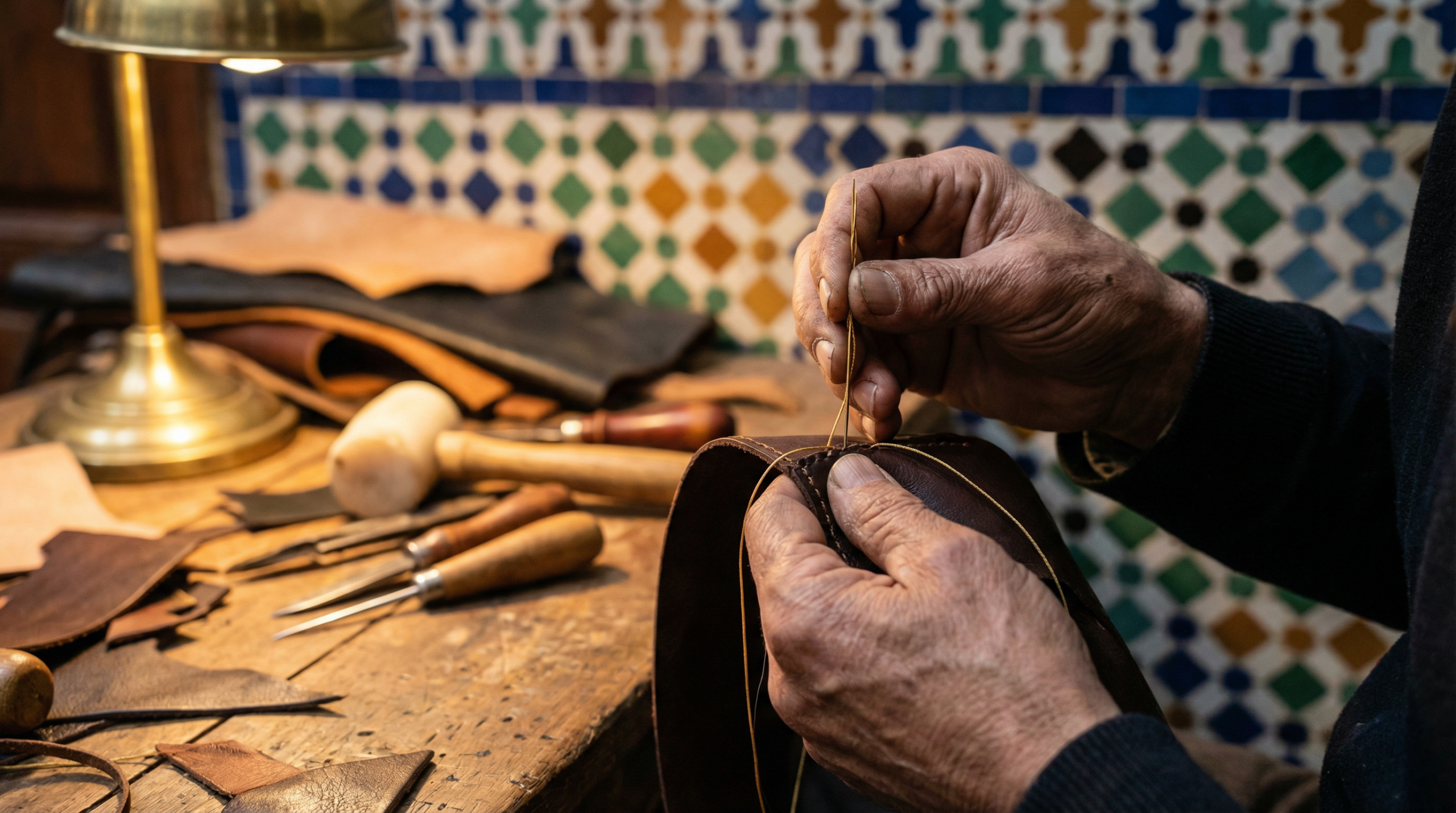
In French, the whole leather-goods trade is called “maroquinerie”. The word comes from “maroquin”, a goatskin leather that Europe bought from Morocco, and it has been in the French language since 1479. English kept the same trace: it calls that leather “morocco”.
A leather before it was a trade
Maroquin is first of all a material: goatskin tanned with sumac or with gall nut, two vegetable tannins. It is recognised by its visible grain, wide and irregular, and by its strength: it can be folded, opened and handled thousands of times.
The word enters French at the end of the Middle Ages. The Trésor de la langue française, the reference dictionary of the French language, records “peaulx de maroquins” in 1479, then “marroquin” in Rabelais, in Le Quart Livre, in 1552. On its origin the dictionary is clear: the word is formed on “Maroc”, the French name of Morocco, probably by way of Spanish.
From maroquin to maroquinerie
In 1636, “marroquinerie” means “the work and the art of the maroquinier”: the working of that particular leather, and of no other. By 1723 the word names the workshop where it is made; by 1846, its trade.
The meaning the French use today is recent. Only in 1933 does “maroquinerie” come to mean the shop that sells all kinds of leather objects. By then the word has left the goat and the sumac behind: it covers the bag, the wallet and the belt, whatever the hide.
The leather of books and ministers
Because it withstands handling and shows gilding well, maroquin becomes, from the end of the sixteenth century, the leather of fine bookbinding: the leather of books made to be opened often. English-speaking bookbinders still call it morocco.
In the eighteenth century, “maroquin” also names the leather portfolio in which business papers are kept on a desk (1752). From there comes an expression still alive in French political journalism: to “land a maroquin” is to be given a ministry. The sense of “ministerial portfolio” is recorded in 1901.
The name of a route as much as a place
The name says where Europe received this leather from, not always where each hide was tanned. The historian Walter Rodney recalls that part of the “Moroccan leather” was tanned and dyed by Hausa and Mandinka craftsmen, in the north of present-day Nigeria and in Mali, before reaching Europe through North Africa.
So Morocco was two things at once: a country of tanners, and the door through which this leather entered Europe. It is that door the word remembers.
What remains of the word, in Morocco
The craft itself never left the country. In Fez, the tanneries of the medina still work in the open air, in stone vats. The largest, Chouara, is often described as one of the oldest in the world. The Medina of Fez has been on UNESCO’s World Heritage List since 1981.
It is from this heritage that the House takes its name: Miratti comes from “mirath”, Arabic for heritage. Our pieces are not morocco in the strict sense: we work full-grain cowhide, thicker, made for a briefcase that carries a laptop every day. The rest has not changed: choosing the hide, cutting it, assembling it by hand, in Casablanca. Our story tells what came next.
Milestones
- 1479 “Peaulx de maroquins”: the first use of the word recorded by the Trésor de la langue française.
- 1552 Rabelais writes “marroquin” in Le Quart Livre.
- 1636 “Marroquinerie”: the work and the art of the maroquinier.
- 1723 The word names the establishment where maroquin is made.
- 1752 “Maroquin” names the leather portfolio in which business papers are kept.
- 1933 “Maroquinerie” takes its present French meaning: the shop that sells leather goods.
- 1981 The Medina of Fez is inscribed on UNESCO’s World Heritage List.
Read next: how to choose a leather briefcase, in seven points.
Sources
- Trésor de la langue française informatisé, etymology of “maroquin” and “maroquinerie”, CNRTL (in French).
- UNESCO World Heritage Centre, “Medina of Fez”, property no. 170, inscribed in 1981.
- Walter Rodney, How Europe Underdeveloped Africa (1972).